

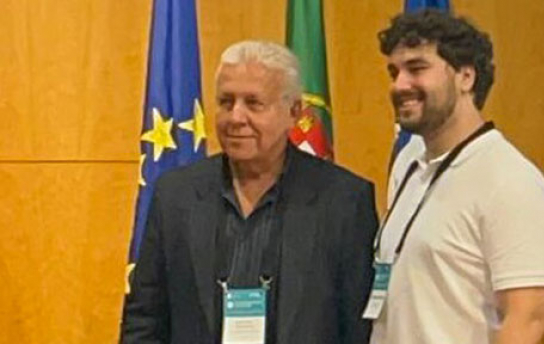
Miguel Rosa, a final-year student in the Bachelor’s degree in Electronics, Telecommunications and Computer Engineering of the ISEL, won first prize in the student category of the international competition promoted by the H2O & Sustainability Innovation Hub, held on October 14 and 15 at the University of Algarve, on the Penha Campus in Faro.The winning project, titled “Smart System for Microplastics Quantification and Analysis in Water”, was developed under the co-supervision of ISEL professors António Serrador and Nuno Datia, and Jan Halfar, professor at VSB – Technical University of Ostrava (Czech Republic).This is the first ISEL undergraduate final project developed in collaboration with the U!REKA European network. Its goal is to deepen understanding of the presence of microplastics in the watersheds of the municipalities of Oeiras and Lisbon, including their impact on the marine environment, thereby contributing to research and monitoring of one of today’s most pressing environmental challenges.The project also received support from the Municipal Councils of Oeiras and Lisbon, strengthening collaboration between higher education institutions, local authorities, and innovation ecosystems dedicated to sustainability, the blue economy, and environmental transition.The recognition achieved by Miguel Rosa highlights the work carried out at ISEL and within the Polytechnic of Lisbon in promoting applied research and technological solutions with real social impact — helping to train professionals capable of addressing the environmental challenges of both the present and the future.Text by MFC/GCIImages courtesy of the University of Algarve
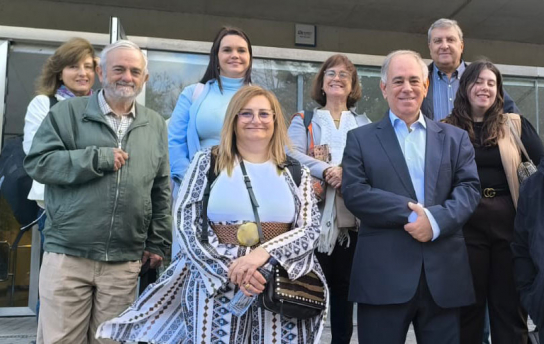
From October 19 to 22, Nuno Henriques (DEM/ISEL), an ISEL faculty member accredited as a EUR-ACE evaluator, joined the team of experts appointed by the CAAAE (Central Asian Association for Accreditation of Education), an accreditation agency of ENAEE (European Network for Accreditation of Engineering Education), to conduct a EUR-ACE accreditation visit to TECNUN – School of Engineering, University of Navarra (Spain).Nine engineering education programs at that institution were submitted for international accreditation with the EUR-ACE label, including the Bachelor’s degrees in Mechanical Engineering and Electrical Engineering, in which the ISEL professor was directly involved.The delegation included specialists from Portugal (ISEL and ISEP), as well as from universities in Spain, Colombia, Kazakhstan, and Ecuador.The EUR-ACE label is a European quality mark for engineering programs, certifying their compliance with European quality standards and recognizing the excellence and high standard of the education provided.
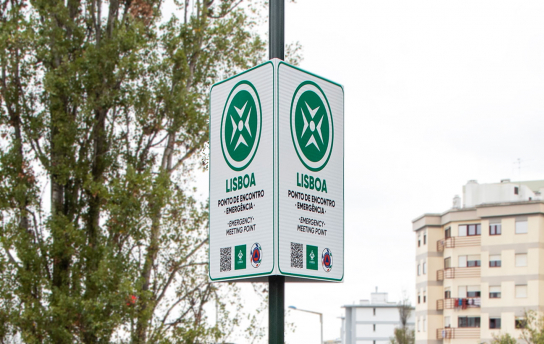
On October 28, the signage identifying one of the 86 Emergency Meeting Points across the city of Lisbon was installed in the ISEL parking lot. This initiative is part of the Lisbon City Council’s policy to implement and identify designated safe areas where the population should gather in the event of major accidents or disasters, facilitating the coordination of rescue operations and the assistance provided by emergency teams.The occasion was attended by representatives from the Lisbon Municipal Civil Protection Service (SMPC) — Margarida Castro Martins, Director of the SMPC Lisbon; Raquel Milho, Head of the Public Prevention and Awareness Division; and engineers Edgar Vaz and Luís Mesquita. ISEL was represented by Vice-President Alexandra Costa, Vanda Pacheco, Head of the Infrastructure and Equipment Management Service, and Paula Castro, Head of the Hygiene, Health, and Safety Unit.See the photo album on Flickr.
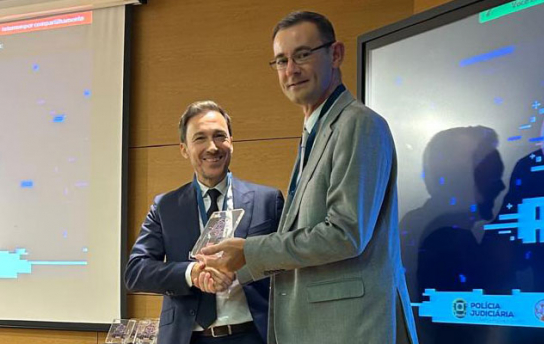
ISEL and the Portuguese Criminal Investigation Police (PJ) have developed the educational game “Rage Quit”, an interactive experience that will be implemented nationwide in secondary schools. The game “transforms an ordinary school day into a series of episodes in which the player is responsible for the consequences of their decisions,” as stated by the PJ in a press release.The platform on which the game was developed was created by students João Pires and Tiago Neves as part of the Project course unit of the Bachelor’s Degree in Informatics and Multimedia Engineering.The initiative was presented on October 14th, as part of the celebrations of the PJ’s 80th anniversary. The conference “Cybercrime in Focus: Trends and Prevention in the Digital Age” featured the participation of ISEL’s President, Professor José Nascimento, representing the institution.
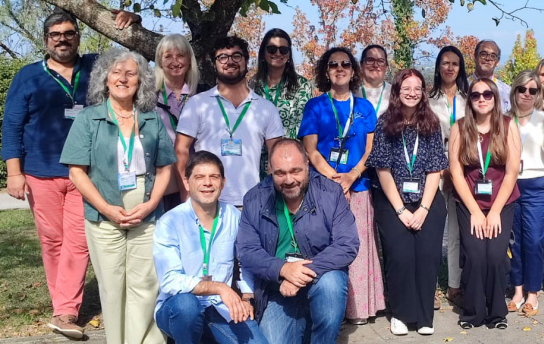
On October 16th and 17th, the Coimbra Business School, part of the Polytechnic Institute of Coimbra, organized the 7th Sustainable Campus Conference (CCS2025). Under the theme "Sustainability in Action: Connecting Higher Education Institutions and the Community for a Green Future," the conference was inspired by the principles of the United Nations' 2030 Agenda and highlighted the transformative role of Higher Education Institutions in training citizens and leaders committed to a more sustainable future.The event was attended by representatives from various organic units of the Polytechnic Institute of Lisbon (IPL), including the School of Social Communication (ESCS), the Lisbon School of Education (ESELx), the Lisbon School of Health (ESSL), the Lisbon Institute of Accounting and Administration (ISCAL), the Lisbon Institute of Engineering (ISEL), as well as the Central Services of the Presidency and the Social Action Service of the IPL.ISEL was represented by professors Alexandra Costa, Alexandra Rodrigues, Ana Maria Barreiros, João Garcia, Manuel Matos, and Patrícia Barata, who presented and shared projects and experiences developed at the institute. Their presentations highlighted the contribution of engineering to the creation of innovative and sustainable solutions, reinforcing ISEL's commitment to integrating sustainability into its practices, teaching, and research.
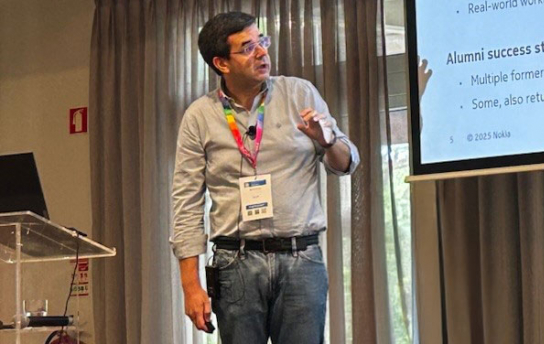
On October 15th, Professor Nuno Cruz (DEI/ISEL) took part in the SR Experts Portugal event, where he presented the results of the strategic partnership between ISEL and Nokia, which focuses on practical and advanced training in Network Technologies.During the presentation, the professor highlighted the key benefits of the collaboration, such as the laboratory equipped with Nokia technology and training programs aimed at network automation. These courses cover areas like automated network administration and technical content, following a hands-on training approach that prepares students for the job market.Nuno Cruz also shared examples of final-year projects completed in 2025, emphasizing that several former students who took part in this training are now working at Nokia. Some have even returned to ISEL as guest lecturers, further strengthening the link between education, innovation, and industry.